
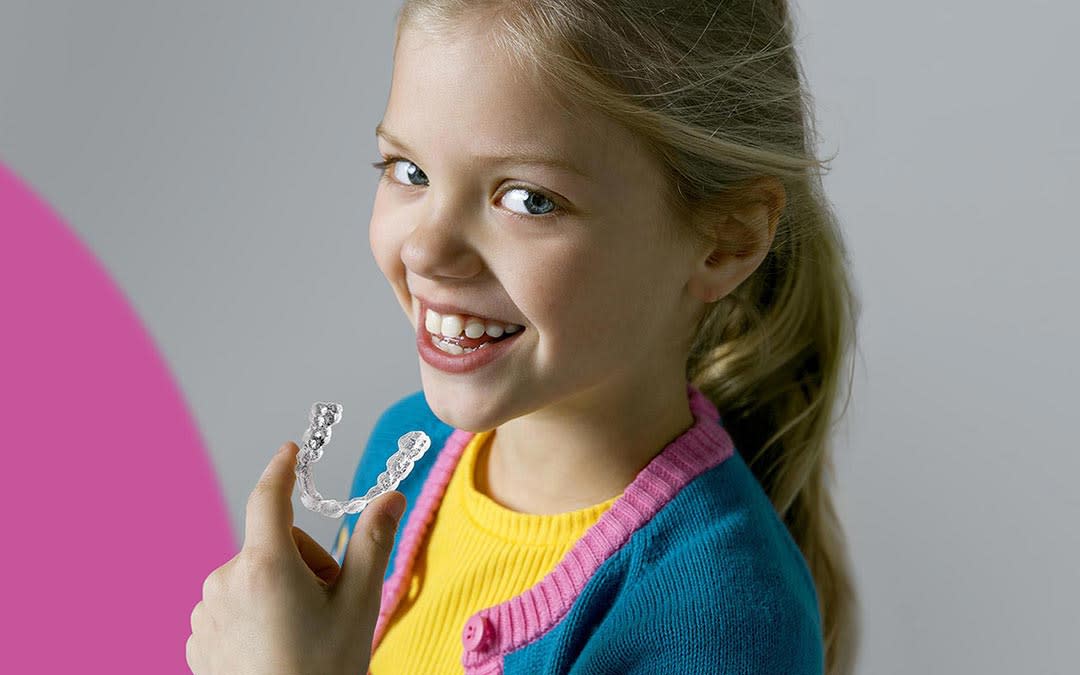


Has your child's dentist mentioned orthodontic treatment? You're not alone — and there's great news. Invisalign First clear aligners are designed specifically for growing children ages 6 to 10. This guide answers the most common questions parents ask about Phase 1 orthodontic treatment, clear aligners for kids, and what to expect at every step.
At a glance: key facts about Invisalign First clear aligners
Who it is for: Children ages 6 to 10 with a mix of baby and permanent teeth
What it treats: Crowding, crossbite, narrow arches, deep bite, spacing, and bite issues — from simple to complex
How it works: A series of customized, removable clear aligners that guide teeth and arch development over time
First AAO check-up: The American Association of Orthodontists recommends every child have their first orthodontic evaluation no later than age 71
Why early matters: The jaw is still growing and most responsive to guidance at ages 6–10, making treatment more effective and less invasive than waiting
Designed for mixed dentition: Eruption compensation technology adapts the plan as new adult teeth come in
Recommended by orthodontists: 100% of surveyed orthodontists recommend Invisalign First treatment for growing children2
High compliance: 86% of surveyed orthodontists agree young patients are highly compliant with Invisalign First treatment3
Fewer office visits: On average 30% fewer doctor visits required compared to fixed appliance patients4
Invisalign First clear aligners vs. traditional Phase 1 appliances
Comfort
Invisalign First clear aligners: Smooth, removable — no metal brackets or wires against soft tissue. 97% of orthodontists rate it comfortable vs. traditional appliances5
Traditional fixed/functional appliances: Metal hardware fixed in place; can cause irritation and soreness
Oral hygiene
Invisalign First clear aligners: Remove to brush and floss normally — no special tools needed. 79% of orthodontists agree patients experience better oral hygiene vs. functional appliances6
Traditional fixed/functional appliances: Food traps and difficult cleaning around wires increase plaque and gum inflammation risk
Speech
Invisalign First clear aligners: 88% of orthodontists agree treatment does not interfere with patients' speech7
Traditional fixed/functional appliances: Fixed hardware can affect speech more noticeably and for longer
Compliance (will my child actually wear it?)
Invisalign First clear aligners: 86% of orthodontists agree young patients are highly compliant3
Traditional fixed/functional appliances: Fixed in place — compliance not required, but can't be removed for comfort
Emergency appointments
Invisalign First clear aligners: 99% of orthodontists agree younger patients have fewer emergency appointments than those in braces8
Traditional fixed/functional appliances: Broken wires and loose brackets are common causes of unplanned visits
What it addresses
Invisalign First clear aligners: Tooth alignment + arch development + space creation for incoming teeth — all in one system
Traditional fixed/functional appliances: Often requires multiple separate appliances (expander + partial braces) at the same time
Parent preference
Invisalign First clear aligners: 3 out of 4 surveyed parents prefer Invisalign First clear aligners over braces for their 6–10 year old9
What is Invisalign First treatment?
Invisalign First is Phase 1 orthodontic treatment for children ages 6 to 10. It uses Invisalign® clear aligners built specifically for kids who still have a mix of baby teeth and incoming adult teeth. Invisalign First treatment is the first clear aligner product designed with features specifically for younger patients.10
Unlike standard Invisalign treatment for teens and adults, Invisalign First treatment targets jaw and arch development during the most responsive years. Orthodontists use it to address crowding, crossbite, deep bite, narrow arches, and spacing, often stopping problems before they become more serious (and more expensive) later on.
What is the difference between Invisalign First treatment and regular Invisalign treatment?
Invisalign First treatment is for children ages 6–10 with baby teeth still in place. Regular Invisalign treatment is for teens and adults with a full set of permanent teeth.
The difference comes down to what each system is designed to do. Invisalign First clear aligners include a feature called eruption compensation, which means the plan automatically adapts as new adult teeth come in during treatment. They also guide how the jaw and arches develop, creating space for incoming teeth.
Regular Invisalign treatment moves teeth into final alignment after all permanent teeth have erupted. It does not address arch development or mixed dentition.
In short: Invisalign First treatment handles the growth phase. Regular Invisalign treatment handles the finishing phase. Some children who complete Invisalign First clear aligners go on to Phase 2, but many find that early treatment reduces how much Phase 2 work is needed.
What age is Invisalign First clear aligners for?
Most professional orthodontic organizations recommend a first orthodontic evaluation by age 7. At this age, an orthodontist offering Invisalign treatment can spot developing alignment issues while the jaw is still forming, making any needed treatment more effective and less invasive.
Not every child who visits at age 7 will need treatment immediately, but an early evaluation gives parents and providers the chance to monitor development and act at exactly the right time. If your child is approaching age 6 and alignment has come up at a dental visit, now is the right time to ask about Invisalign First clear aligners.
When should my child have their first orthodontic evaluation?
The recommendation from the American Association of Orthodontists (AAO) is no later than age 7.1
By age 7, most children have enough permanent teeth for an orthodontist to evaluate jaw and bite development, even when everything looks fine from the outside. The goal isn’t to start treatment at 7. It’s to catch issues that are much easier to fix while your child is still growing.
There’s also a financial reason to act early. Catching orthodontic issues during this window may help you avoid more costly or invasive treatments later.11 Most AAO orthodontists offer free or low-cost initial consultations. There is no downside to a first visit.
If your child is approaching age 7 and hasn’t seen an orthodontist yet, scheduling an evaluation is a simple, no-commitment step that gives you peace of mind.
Is my child a good candidate for Invisalign First clear aligners?
Invisalign First clear aligners treat a wide range of orthodontic issues in kids — from simple crowding to more complex bite and arch problems. Ask your child’s dentist or orthodontist about an evaluation if you notice any of these signs:
Crowding or overlapping teeth
A crossbite (upper and lower teeth don’t align properly when biting)
A narrow upper arch or a palate that looks high and V-shaped
A noticeable overbite or underbite
Difficulty chewing, biting, or breathing through the nose
Thumb- or finger-sucking that continued past age 5
Early or late loss of baby teeth
Teeth that look shifted or noticeably asymmetrical
Not all of these signs mean treatment is needed right away. But catching them early gives your child’s orthodontist the best window to act. An orthodontist offering Invisalign treatment can tell you whether Phase 1 treatment makes sense now, or whether monitoring over the coming months is the right call.
Can my child get Invisalign treatment if they still have baby teeth?
Yes. Invisalign First treatment is specifically designed for kids who still have a mix of baby and adult teeth, that’s the whole point. One of its most important features is eruption compensation, which automatically adjusts the treatment plan as new permanent teeth come in. 86% of surveyed Invisalign orthodontists are satisfied with the eruption compensation features for Invisalign First treatment for mixed dentition patients.12
This means the system adapts alongside your child’s growing smile. Treatment doesn’t need to stop or restart when a new tooth erupts. A provider experienced in Invisalign treatment will build a plan that works with your child’s exact developmental timeline, baby teeth included.
How do Invisalign First clear aligners work?
Invisalign First treatment uses a series of removable clear aligners, each gently moving teeth into better positions. Each set is custom-made for your child’s mouth and worn for a set period before moving to the next. Because aligners are removable, kids can eat, brush, and floss normally — no food restrictions, no wire-cleaning tools.
A narrow jaw is one of the most common reasons children need Phase 1 treatment — and expanding the arch is where Invisalign First treatment truly stands out. Think of the dental arch as the U-shaped curve that holds your child's teeth. When that curve is too narrow, there is not enough space for adult teeth to come in straight. Gently widening it early — while the jaw is still developing — can create that room naturally and reduce the need for more complex treatment later.
The data backs this up. 89% of Invisalign First cases have an average of up to 6mm of dental arch expansion planned on upper permanent first molars.13 To put that in perspective, 6mm is roughly the width of a pencil eraser — a modest measurement that can make a meaningful difference for incoming adult teeth.
When an orthodontist uses a molars-first approach, the results are similarly encouraging: 90% of Invisalign First cases have on average of 4.6mm dental arch expansion planned on upper first molars with molars move first staging pattern.14 Your child's orthodontist will choose the approach that best fits their specific needs.
Families also benefit from fewer appointments. 96% of Invisalign orthodontists agree that Invisalign First treatment is more convenient for the patient by minimizing the need for multiple appliances during phase 1 treatment.15 That means fewer disruptions to your family’s schedule and do more of what you love.
The aligners are also made from SmartTrack™, a clinically proven material designed to improve tooth movement.16 This means each aligner applies consistent, controlled force, guiding your child’s teeth and arches predictably at every stage.
And when something unexpected happens? It usually doesn’t require a trip to the office. 99% of surveyed Invisalign trained orthodontists agree that active younger patients in Invisalign treatment have fewer emergency appointments than those in braces.8 Overall, Invisalign patients require on average 30% fewer doctor visits than fixed appliance patients.4 No broken wires. No emergency repairs. Just steady, predictable progress.
How long does Invisalign First treatment take?
Phase 1 treatment typically lasts several months, but the exact timeline depends on your child’s specific needs. Because Invisalign First treatment targets a specific developmental issue — like arch expansion or bite correction — it is generally shorter than a full Phase 2 course.
Your child’s orthodontist will review X-rays and assess their growth stage before giving you a personalized estimate. Most Phase 1 plans include a series of aligner sets worn over several months, followed by a monitoring period as remaining adult teeth continue to come in. The most accurate way to plan is to schedule a consultation with a provider near you.
Results may vary. Consult your orthodontist or dentist to determine if Invisalign treatment is right for you.
How many hours a day does my child need to wear the aligners?
According to many dentists and orthodontists, aligners generally need to be worn for approximately 20 to 22 hours per day for Invisalign First clear aligners to work. That means they stay in during school, at home, and while sleeping. They come out only for meals, snacks, and brushing.
Building a simple routine makes this easy: remove aligners for meals, brush after eating, put them straight back in. Because the aligners are smooth and comfortable with no wires or brackets, most children adapt quickly. Orthodontists consistently report strong compliance among patients ages 6 to 10. If your child struggles at first, the adjustment period is usually brief.
Results may vary. Consult your orthodontist or dentist to determine if Invisalign treatment is right for you.
Are Invisalign First clear aligners comfortable for kids?
Yes, comfort is one of the main reasons parents and orthodontists choose Invisalign First clear aligners over traditional appliances. There are no metal brackets or wires pressing against soft tissue. The aligners are smooth, snug-fitting, and designed for a child’s active lifestyle. 90% of surveyed Invisalign orthodontists agree that Invisalign First treatment is not as painful* for Phase 1 patients as traditional functional appliances.17
The numbers back this up. 97% of surveyed Invisalign orthodontists agree that Invisalign First treatment is comfortable for their patients to wear when compared to traditional fixed and functional appliances.5
Parents also worry about whether clear aligners affect speech. The answer is reassuring. 88% of surveyed Invisalign orthodontists agree that Invisalign First treatment does not interfere with their patients' speech.7 Most children adapt to speaking with their aligners in within a few days.
Will my child actually wear their aligners?
This is one of the most common questions, and the data is strongly encouraging. 86% of surveyed Invisalign orthodontists agree that their young patients are highly compliant with Invisalign First treatment.3
Why does compliance work so well? The aligners are genuinely comfortable. There are no sharp wires or brackets causing irritation. Kids notice the difference from day one. For younger children who need a little extra motivation, there are fun personalized stickers they can put on their aligners to make them feel their own. A majority of surveyed Invisalign orthodontists agree that offering Invisalign Stickables encourages Invisalign treatment acceptance.18 When treatment feels like it belongs to your child, keeping aligners in becomes much easier.
What about my child’s oral health during treatment?
Keeping teeth clean is much easier with Invisalign First clear aligners than with traditional fixed appliances. Because the aligners are removable, your child simply takes them out to eat and brush. No special tools, no cleaning around wires.
The research confirms this. 79% of surveyed Invisalign orthodontists agree that Phase 1 patients treated with Invisalign First aligners experience better oral hygiene than for those patients treated with functional fixed appliances.6 Overall, 92% of surveyed Invisalign orthodontists agree that Phase 1 patients treated with Invisalign First aligners experience better quality of life than those patients treated with functional appliances.19
Clinical evidence supports this too. During 12 months of orthodontic therapy, teenager patients treated with Invisalign clear aligners demonstrate better compliance with oral hygiene and present less plaque and gingival inflammatory reactions than their peers with fixed appliances.20 For parents worried about gum health during treatment, this is reassurance backed by peer-reviewed science.
Results may vary. Consult your orthodontist or dentist to determine if Invisalign treatment is right for you.
How do Invisalign First clear aligners compare to braces for kids?
When parents compare Invisalign First clear aligners to braces, most prefer the clear aligner option. 3 out of 4 surveyed parents of children ages 6-10 would prefer Invisalign First clear aligners over braces.9
The orthodontists who use it agree. 100% of surveyed Invisalign orthodontists recommend Invisalign First treatment for growing children.2 And that confidence extends to peer recommendations: 93% of Invisalign orthodontists would recommend Invisalign First clear aligners for Phase 1 treatment to colleagues.21
The real-world track record is growing fast. Globally over 95.7K younger patients have been treated with Invisalign First clear aligners.22 Your child’s care is supported by a large and growing body of real-world outcomes.
Is Invisalign First treatment better than a palate expander?
If your child needs arch expansion, Invisalign First treatment and the Invisalign Palatal Expander System can work together, no screw-turning required. The Invisalign system now includes a removable expander option built specifically for children. Invisalign Palatal Expander is the only FDA-cleared removable palatal expander.23 Unlike traditional fixed expanders that require daily manual adjustment, Kids get the orthodontic care they need, without the dreaded screw-turning of traditional expanders.24
The Invisalign Palatal Expander System works alongside Invisalign First treatment as part of a complete early treatment plan for children ages 6 to 11. If your child’s orthodontist recommends arch expansion alongside tooth alignment, ask whether the Invisalign Palatal Expander System is available. It may let your child address both concerns with coordinated, removable appliances and no screw-turning.
What happens after Invisalign First treatment is complete?
After Phase 1, your child’s orthodontist continues to monitor their development as remaining adult teeth come in. Whether Phase 2 is needed depends on how things progress. Some children need only monitoring after Phase 1. Others move into a full Phase 2 plan once all permanent teeth are in.
The good news is that orthodontists who use Invisalign First clear aligners for Phase 1 tend to stick with the Invisalign system for Phase 2. 89% of surveyed Invisalign orthodontists who used Invisalign First aligners for Phase 1 treatment prefer using Invisalign aligners for Phase 2 treatment.25 Your child’s provider will already know their history and can build the smoothest path forward.
Does Invisalign First treatment require a Phase 2?
Not necessarily. Invisalign First treatment is designed to fix specific developmental issues during a child’s growth years. Whether Phase 2 is needed depends entirely on how your child’s teeth and jaw develop afterward. A provider experienced in the Invisalign system will monitor progress after Phase 1 and give you an honest answer.
How much does Invisalign First treatment cost?
The cost of Invisalign First treatment varies based on your child’s case complexity, your location, and your provider. Several options may help make it more affordable.
Dental insurance may help cover part of the cost, some plans may contribute up to $3,000 toward orthodontic treatment.26 Health savings accounts (HSAs) and flexible spending accounts (FSAs) let you use pre-tax dollars.27 Many orthodontists who offer Invisalign treatment also have flexible payment plans. Ask about financing options at your first consultation.28
The most accurate way to understand cost is to schedule a consultation. Your provider can review your child’s specific needs and give you a clear picture of what treatment involves, clinically and financially.
Ready to take the next step for your child’s smile?
The best way to know if Invisalign First treatment is right for your child is a conversation with a trained provider. An orthodontist offering Invisalign treatment can evaluate your child’s smile, answer your questions in plain language, and build a personalized plan that works with their growing teeth.
Find an Invisalign treatment provider near you and take the first step toward a healthier, more confident smile for your child today.
Results may vary. Consult your orthodontist or dentist to determine if Invisalign treatment is right for you.