
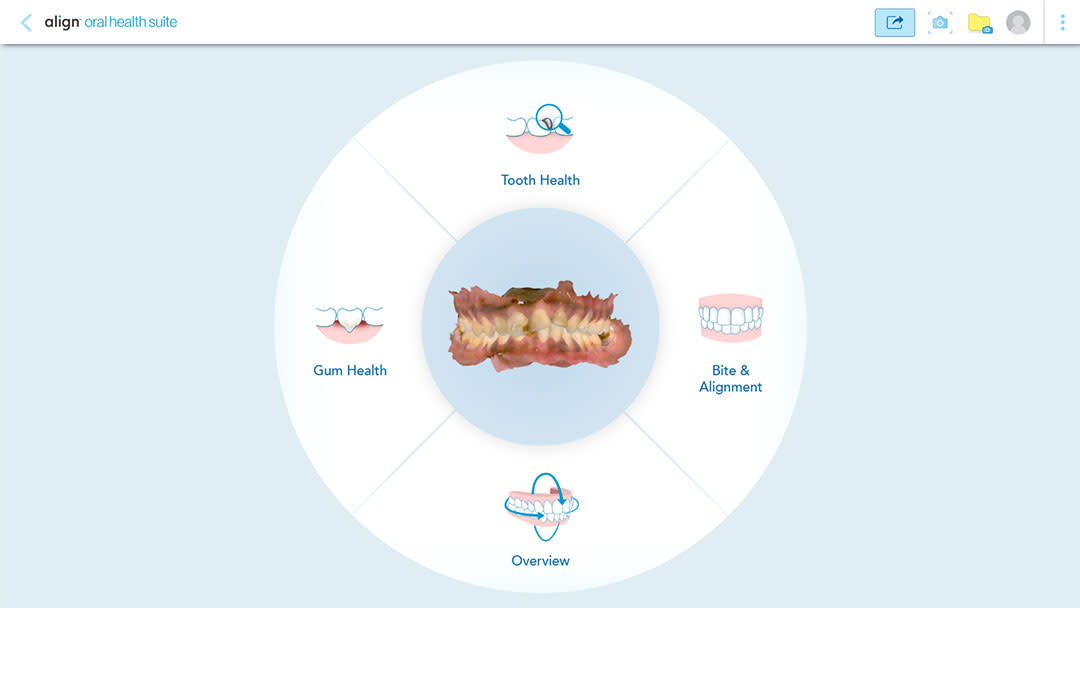


Have you ever had that nagging feeling that something's off with your teeth? Or maybe you've noticed food getting stuck more often, or your jaw aches after a long day — but you're not sure if it's worth bringing up. You're not imagining it. And there's now a better way to find out what's really going on.
An oral health scan gives you and your doctor a complete, detailed picture of your mouth — teeth, gums, bite, and alignment — in a single short appointment. It's the kind of full-mouth check-up that wasn't possible even a few years ago, and it could be the first step toward catching something before it becomes a real problem. Because your mouth is often called the gateway to your overall health, what shows up there can be an early signal for the rest of your body. An oral health scan also helps connect those dots — giving you and your doctor a clearer picture of not just your teeth, but your health as a whole.
Key Benefits of the Invisalign Oral Health Scan
Detect concerns earlier
See a complete 3D view of your mouth
Track changes over time
Improve conversations with your dental provider
Support preventive oral health care
Key statistics at a glance
Numbers speak louder than words when it comes to understanding the value of a digital oral health scan. Here are the data points that matter most — each one backed by clinical research or provider surveys.
96% — How often the scan correctly spots cavities between teeth, matching the accuracy of traditional X-rays. Accuracy of iTero™ NIRI technology in detecting dentinal interproximal caries, compared to bite-wing X-rays1
83% — How much more sensitive iTero NIRI technology is than bite-wing X-rays for detecting proximal enamel lesions.2 Better than traditional X-rays at catching the earliest signs of cavities between teeth.
56% — Reported increase in interproximal caries detection when doctors incorporated the iTero Element™ scanner into their diagnostic protocol.3 More cavities between teeth found by doctors after adding the iTero Element™ scanner to their practice.
59% — How much quicker digital impressions are compared to conventional impressions4
These aren't small improvements — they represent a meaningful leap in what a single dental appointment can tell you and your provider.
Do any of these warning signs sound familiar?
Sometimes the signs that something needs attention are easy to brush off. If any of these feel familiar, an oral health scan is worth asking about at your next visit.
Food is getting stuck in your teeth more than it used to
Your gums bleed when you brush or floss
Your teeth look shorter or more worn than they did a few years ago
You wake up with jaw soreness, or you get tension headaches you can't explain
Gaps between your teeth seem to be widening, or crowding feels worse
You haven't had a thorough dental assessment in more than a year
You've been told you grind your teeth or have gum recession
None of these should be dismissed as "just getting older." Each one can point to something that's much simpler to fix when caught early.
Who should consider getting an oral health scan?
Most adults can benefit from an oral health scan — but it's especially worth it if you're over 30. That's because conditions like gum disease, tooth wear, and bite problems tend to develop slowly and quietly. By the time they actually hurt, they may have been building for years.
If you've noticed any of the warning signs above, or if you simply want a clear baseline picture of your oral health, a scan is a great place to start. It's also a much more comfortable experience than traditional dental impressions — no messy trays, no gagging, and you get to see your results in real time.
What exactly is an oral health scan?
An oral health scan is a quick, comfortable digital scan of your teeth and gums that creates a detailed 3D picture of your entire mouth — all in a single appointment.
Your provider uses the Invisalign Oral Health Scan, which combines advanced scanning technology with AI-powered analysis, to look at your oral health from four different angles: your tooth health, your gum health, your bite, and your alignment. Together, these four areas give a much more complete picture than a standard visual check-up. And because it's digital, your doctor can walk you through what they're seeing right there on screen — in plain language, in real time.
What is the 4-Point Snapshot and what does it check?
The 4-Point Snapshot is the heart of what makes an oral health scan different from a regular dental exam. Instead of a general check-up, it looks at four specific areas that directly affect your long-term oral health.
Tooth Health looks at the surfaces of your teeth — including the tight spaces between them — for early-stage cavities that a mirror and a probe simply can't reach.
Gum Health checks for signs of gum recession or early gingivitis. Both can progress quietly for years before causing obvious symptoms, which is exactly why catching them on a scan matters.
Bite looks at how your upper and lower teeth come together. A slightly off bite is one of the most common causes of jaw pain, headaches, and uneven tooth wear — and most people have no idea it's happening.
Alignment tracks whether your teeth are shifting over time — whether crowding is getting worse or gaps are slowly widening in ways you haven't noticed yet.
Together, these four data points give you the kind of detailed oral health picture that just isn't possible from a visual exam alone.
How does an Invisalign oral health scan work?
An Invisalign oral health scan is simpler than you might expect. Digital impressions are 59% quicker than conventional impressions.4 Your provider guides a small handheld wand gently around your mouth, and a precise 3D model of your teeth and gums builds itself on screen in real time — no biting down on trays, no waiting.
The iTero Element 5D imaging system, which powers scans at many provider offices, does more than create a 3D picture. It uses Near Infrared Imaging (NIRI) technology — a light-based approach that sees inside the structure of your teeth — to flag areas between teeth that could be developing cavities before they become visible. When incorporating iTero Element 5D scanner into their practice surveyed doctors reported that they increased: Interproximal caries detection by 56%3 — which means more early catches, more options, and fewer surprises down the road.
What can an Invisalign oral health scan detect?
An Invisalign oral health scan can detect a wide range of common dental conditions early — often before you feel any symptoms. This includes early-stage cavities, gum recession, plaque buildup in hard-to-clean spots, signs of tooth wear, and early indicators of gum disease.
What makes the technology particularly powerful is how it compares to traditional tools. iTero NIRI technology of the iTero Element 5D imaging system was 83% more sensitive than bite-wing X-ray for proximal enamel lesions detection.2 Early enamel lesions — tiny cavities still limited to the outer layer of your tooth — are the easiest and least invasive to treat. Catching them at this stage is a very different conversation from treating a cavity that has already grown.
Could crowded teeth be putting your gums at risk?
Yes — and this is one of the most overlooked connections in dental health. Non-optimal tooth positioning often involves overlapping and crowded teeth, making it difficult to remove plaque and bacteria, which might compromise oral hygiene.5 Put simply: when teeth are crowded, your toothbrush and floss can't reach the tightest spaces. Plaque builds up exactly where it's hardest to see, — and hardest to remove.
The Alignment component of the oral health scan is designed to surface this kind of concern. When your doctor or dental hygienist can see a 3D model of how your teeth fit together, they can identify areas of crowding that are contributing to gum and hygiene problems, and talk through options before things get worse.
Is your bite putting your oral health at risk?
Your bite affects a lot more than just how your teeth fit together. Misaligned teeth is a common health problem which can impact oral function, oral health, aesthetics and overall well-being.6 Most people think of a "bad bite" as purely cosmetic — but the health implications run deeper. A misaligned bite (malocclusion) can be the underlying cause of jaw pain, headaches, worn teeth, cavities, and gum disease. It may also make it harder to chew, speak, or breathe comfortably.6
A misaligned bite (malocclusion) is closely linked to gum disease.7 That means an off bite isn't just an aesthetic issue — it's a meaningful risk factor for gum disease down the road. The Bite component of the scan is designed to flag this early, when addressing it is straightforward.
Could your oral health be connected to your overall health?
Yes. What happens in your mouth doesn't stay in your mouth. Your gums are not just a dental issue.
Getting treatment early helps prevent other health conditions and supports proper development of the jaw and face.8 Getting an oral health scan isn't just about protecting your teeth, it's about catching small problems before they're connected to bigger health concerns. Think of it as a proactive step for your whole body, not just your smile.
Is an Invisalign oral health scan the same as a regular dental check-up?
Not quite — and the difference matters. A regular dental exam is a visual inspection, sometimes with X-rays. An Invisalign oral health scan adds a new layer of information. The 3D model your doctor creates during the scan becomes a permanent digital record — something they can compare visit to visit to track any changes over time.
What are the benefits of getting an Invisalign oral health scan?
The most immediate benefit is clarity — you leave the appointment actually knowing what's going on in your mouth. But the longer-term benefit is even more valuable: regular scans support a truly preventative approach to dental care. When your teeth are properly aligned, they're easier to keep clean, which helps prevent problems before they start.9
When you can track changes and address concerns while they're still small, you're far less likely to face complex, expensive, or uncomfortable treatments later. Invisalign® aligners help straighten your teeth and support better oral health.10 For many people, a scan is the moment they first understand the connection between their tooth alignment and the gum and hygiene problems they've been dealing with for years.
How does AI make the Invisalign oral health scan smarter?
AI helps your dental provider analyze scan data more consistently — and more thoroughly — than a visual review alone. Rather than relying solely on what can be seen with the eye, AI-assisted tools can flag patterns and potential concerns across every surface of your teeth in seconds.
When you can actually see your scan results on screen, the conversation with your doctor becomes a real dialogue rather than a one-way report. When you understand what's happening and why, making the decision about next steps feels a lot less daunting.
What should I expect during an Invisalign oral health scan appointment?
The whole experience is much simpler — and more comfortable — than most people expect. Here's what actually happens, step by step.
Arrive — no preparation needed. You don't need to fast, skip eating, or do anything special beforehand.
Get comfortable — you'll sit in the dental chair just as you would for a regular check-up.
The scan begins — your provider gently guides a small handheld wand around your teeth and gums. No biting down, no trays, no discomfort.
Watch your mouth appear in 3D — within moments, a detailed model of your mouth is visible on a screen right in front of you.
Review it together — your doctor walks you through the 4-Point Snapshot, explaining what they see in plain language across Tooth Health, Gum Health, Bite, and Alignment.
Discuss what's next — based on the findings, your provider will recommend any follow-up care or monitoring.
The scan itself takes just a few minutes. 100% of patients surveyed said that they liked digital impressions better due to time, taste, gagging, and comfort concerns, and that they would advise a friend to seek out digital impressions.4
How accurate is an Invisalign oral health scan?
Very accurate — and in some ways more accurate than traditional X-rays for early cavity detection. iTero NIRI technology demonstrated 96% accuracy in detecting dentinal interproximal caries when compared to bite wing x-ray (BWX).1 That level of precision is what makes the scan genuinely useful as an early-detection tool, not just a digital version of the same check-up you've always had.
The 3D model produced is detailed enough to support restorative treatment planning, orthodontic case submission, and long-term comparison across visits. It's a permanent record of your oral health — not just a snapshot that gets filed away.
How does addressing what the scan finds support better gum health?
Acting on what the scan finds can make a real difference to your gum health over time. Patients treated with Invisalign® clear aligners have better oral health and greater satisfaction during orthodontic treatment than patients treated with fixed appliances.11 Healthier gums aren't just a cosmetic benefit, — they're a clinical one that matters for your long-term health.
The connection between straight teeth and healthy gums is well-established. Straightening your teeth with Invisalign aligners can enhance oral health.10 When teeth are better aligned, they're easier to clean thoroughly, plaque has fewer hiding spots, and your gum tissue experiences less chronic irritation. For many adults, the scan is the first time they clearly see the link between their tooth positioning and the gum problems they've been managing for years.
What happens if the Invisalign oral health scan finds something?
Finding something early is the whole point — and early findings almost always mean simpler treatment options. If the scan reveals early-stage cavities, your doctor may recommend a straightforward restorative plan. If it flags gum health, bite, or alignment concerns, orthodontic treatment may be discussed as a logical next step.
You stop wondering why your gums keep bothering you, and you start understanding what's actually going on. You leave with a clear picture of what's happening and a real plan for what to do about it.
Why do so many adults choose Invisalign treatment after a scan?
Once you can see what's happening in your mouth in 3D, decisions about treatment become a lot easier. And when orthodontic care is recommended, the evidence for why adults choose Invisalign clear aligners is compelling. Surveyed adults, planning to get their teeth straightened, are 8x more likely to choose Invisalign® treatment (aligners) than braces.12
For adults with busy lives, the commitment is also much more manageable than many expect. Invisalign® patients require on average 30% fewer doctor visits than fixed appliance patients.13 Treatment with Invisalign® clear aligners completed 5 months faster than treatment with braces.14
And during treatment, the results for gum health and daily comfort are noteworthy. Adults treated with Invisalign® clear aligners experienced less pain than braces.15 95% of dental hygienists agree that most patients have less visible plaque in patients undergoing Invisalign® treatment than patients undergoing fixed appliance treatment.16 The scan is just the starting point — and for many adults, it's the moment that makes the next step feel completely doable.
How can I get an Invisalign oral health scan?
Invisalign oral health scans are available at dental and orthodontic practices equipped with an iTero scanner. The easiest way to find out is simply to contact your dentist or orthodontist and ask whether they offer an Invisalign oral health scan. If they don't, you can use the Invisalign provider locator to find a qualified provider near you.
Ready to see the bigger picture? Get your Invisalign oral health scan today
Your mouth can tell you a lot — if you have the right tools to listen. Whether you've noticed some of the warning signs above, you're overdue for a thorough check-up, or you just want a more complete picture of your oral health, an oral health scan is quick, comfortable, and genuinely informative.
Talk to your Invisalign provider about scheduling your Invisalign oral health scan today. The earlier you know, the more options you have.
Results may vary. Consult your orthodontist or dentist to determine if Invisalign treatment is right for you. Invisalign clear aligners are not suitable for everyone. Treatment outcomes depend on individual patient factors.
Frequently asked questions (FAQ)
What is an Invisalign oral health scan?
An Invisalign oral health scan is a non-invasive digital scan of your teeth and gums that builds a detailed 3D model of your mouth in minutes. It reviews four key areas — Tooth Health, Gum Health, Bite, and Alignment — to help your dental provider screen for early-stage cavities, gum recession, plaque buildup, tooth wear, and early signs of gum disease, all in a single appointment.
How long does an Invisalign oral health scan take?
Most Invisalign oral health scans take just a few minutes. Your provider guides a small handheld wand gently around your mouth, and you can watch the 3D model build in real time on a screen in front of you. There are no trays, no putty, and no waiting around.
Is the Invisalign oral health scan covered by dental insurance?
Coverage varies by insurance plan and dental office. It's worth calling your insurance provider before your appointment — or simply asking at the front desk — to find out what's included.
Can an Invisalign oral health scan detect cavities?
Yes. The iTero imaging system in the Invisalign oral health scan uses NIRI technology to detect cavities between teeth with 83% greater sensitivity than traditional bite-wing X-rays for enamel lesions, and demonstrated 96% accuracy in detecting dentinal interproximal caries.2,1 This makes it especially effective at catching early-stage cavities — the kind that are easiest to treat.
Can a bite problem really affect my overall health?
Yes. A misaligned bite — known as malocclusion — has been linked to jaw pain, headaches, tooth wear, cavities, and gum disease. There is also a well-established association between malocclusion and the development of periodontal disease,7 which has its own connections to broader systemic health. The Bite component of the oral health scan is specifically designed to catch these issues early.
What happens if the scan finds a problem?
Your doctor will explain the findings in plain language and recommend next steps. These might include restorative care, hygiene treatment, or a conversation about orthodontic options. Finding something during a scan — before it causes pain — almost always means simpler, less expensive, less stressful treatment. That's the whole point.
Results may vary. This content is provided for general informational and educational purposes only and is not medical, dental, or orthodontic advice. Align Technology does not practice dentistry or medicine or provide healthcare services. Consult your orthodontist, dentist, or other qualified healthcare professional to determine whether Invisalign treatment is right for you.