
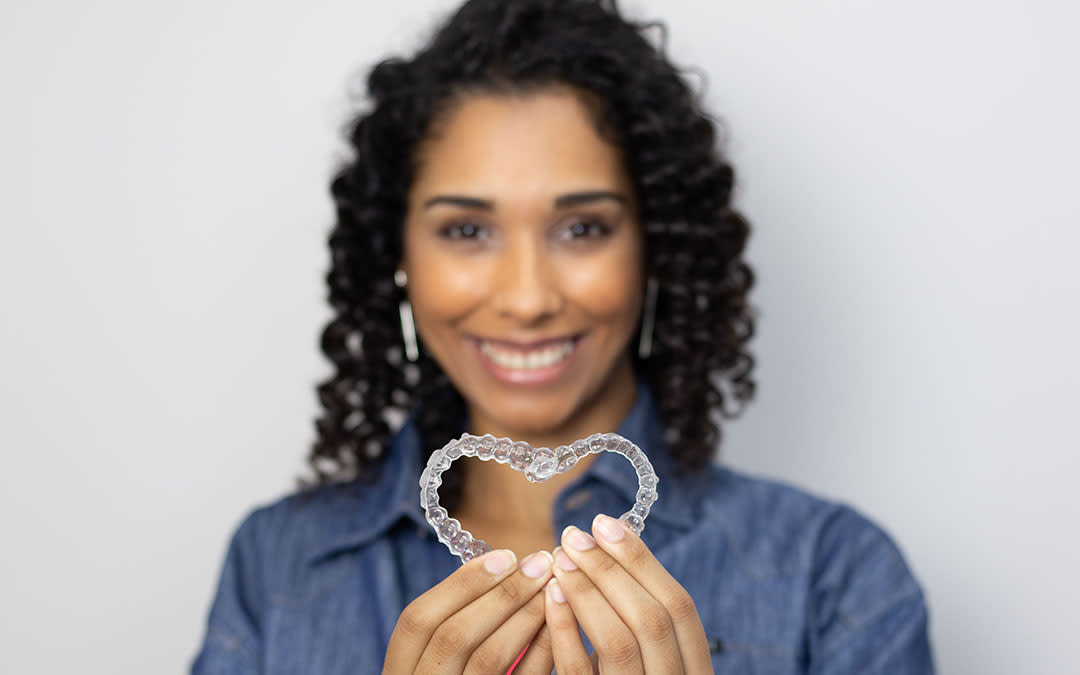


If you've been thinking about straightening your teeth, you've probably heard people rave about their Invisalign treatment experience. Over 24 million patients have been treated worldwide with the Invisalign System.1 Here's what makes it such a popular choice.
Quick answers: Why patients love Invisalign clear aligners
Why do patients choose Invisalign treatment over other aligners? The majority of adults would choose Invisalign treatment over other aligners.2
Are Invisalign treatment patients more satisfied than braces patients? Yes. Invisalign patients are more satisfied with their overall patient experience than metal braces patients.3
Are Invisalign clear aligners more comfortable than braces? Yes. Invisalign clear aligners are more comfortable than metal braces.4
Does Invisalign treatment cause less pain than braces? Yes. Adults treated with Invisalign clear aligners experienced less pain and fewer negative impacts on their lives during the first week of orthodontic treatment than did those treated with fixed appliances.5
How much faster is Invisalign treatment compared to braces? Treatment with Invisalign clear aligners completed 5 months faster on average than treatment with braces.6 The average Invisalign treatment time is 12 to 18 months.7
Does Invisalign treatment work as well as braces? Yes. Invisalign treatment delivers results equivalent to braces.8
How much does Invisalign treatment cost? Invisalign treatment may cost the same or less than braces.9 Find a doctor and ask about cost, insurance, and payment plans. Your dental insurance may cover up to $3,000 in orthodontic treatment.10
Does Invisalign treatment support better oral health? Yes. 95% of dental hygienists agree that most patients have less visible plaque in patients undergoing Invisalign treatment than patients undergoing fixed appliance treatment.11
How many patients have been treated with Invisalign treatment? Over 24 million patients have been treated worldwide with the Invisalign System.1
Invisalign treatment by the numbers
Here's a quick snapshot of the key data behind Invisalign treatment. Each figure is backed by clinical research, survey data, or company records.
Why do patients choose Invisalign clear aligners over other options?
The majority of adults would choose Invisalign treatment over other aligners.2 Patients pick Invisalign clear aligners for three main reasons: they're nearly invisible, you can remove them for eating and cleaning, and the treatment fits into a busy lifestyle.
The American Association of Orthodontists notes that clear aligners are virtually invisible, made from smooth transparent plastic, and can be removed to maintain your usual diet and hygiene routine.17 That combination of discretion and flexibility is exactly what draws many patients to Invisalign treatment.
Whether you're a professional who interacts with clients all day, a parent juggling a packed schedule, or simply someone who wants to feel confident during treatment, Invisalign clear aligners let you straighten your teeth without putting your life on hold.
Can you preview your smile before starting Invisalign treatment?
Yes. Using a digital scanner, your doctor creates a 3D model of your teeth and shows you a simulation of your future smile before you begin. Seeing your potential results upfront gives you the confidence to move forward.
This digital approach means no messy putty impressions. A quick scan captures your teeth in detail, and your doctor uses it to build a personalized treatment plan.18
Is Invisalign treatment more comfortable than braces?
Yes. Invisalign clear aligners are more comfortable than metal braces.4 That difference matters when you'll be wearing your aligners for months. Unlike braces, which use metal brackets and wires that can irritate your mouth, Invisalign clear aligners are made from smooth, customized plastic that fits snugly over your teeth.
The comfort starts with the material. Aligners made from SmartTrack ™ material provide better fit, better comfort, and are easier to insert and remove than Invisalign aligners previously made from single layer (EX30) material.19 Each set is also trimmed to follow your gum line, which helps avoid the irritation that brackets and wires can cause.
Does Invisalign treatment cause less pain than braces?
Yes. Adults treated with Invisalign clear aligners experienced less pain and fewer negative impacts on their lives during the first week of orthodontic treatment than did those treated with fixed appliances.5 The first week is often the toughest part of any orthodontic treatment, so starting with less discomfort makes a big difference.
Research also shows that patients with braces tend to use more pain medication during those early days. Some pressure is normal when you start any treatment — that's how teeth move. But the gentler, more controlled force of Invisalign clear aligners tends to be easier to tolerate.
What makes Invisalign clear aligners convenient for daily life?
Invisalign patients require on average 30% fewer doctor visits than fixed appliance patients.13 That means less time in a waiting room and more time living your life. Emergency visits with Invisalign clear aligners occur almost 80% less frequently than with braces.14 Fewer broken brackets and poking wires means fewer unexpected trips to the office.
The American Association of Orthodontists explains that clear aligners must be removed when you eat or drink and when brushing and flossing, which means there are no food restrictions.20 You can keep enjoying popcorn, apples, and all your favorite foods. Daily hygiene is simple too: you brush and floss normally, with no threading floss under wires.
Clear aligners should be worn 20 to 22 hours per day for best results. You take them out for meals and cleaning, then put them right back in.
Does Invisalign treatment support better oral health?
Yes. 95% of dental hygienists agree that most patients have less visible plaque in patients undergoing Invisalign treatment than patients undergoing fixed appliance treatment.11 Less plaque means healthier gums and a lower risk of enamel issues while your teeth are moving.
Cleveland Clinic notes that proper tooth alignment helps improve oral health and function, reducing the risk of cavities and gum disease.21 Because you can remove Invisalign clear aligners to brush and floss normally, maintaining your oral health routine is easy during and after treatment.
Is Invisalign treatment faster than braces?
Yes. Treatment with Invisalign clear aligners completed 5 months faster on average than treatment with braces.6 The average Invisalign treatment time is 12 to 18 months.7 Depending on your case, you may be able to get the smile you want in as little as six months.12
A 2026 randomized clinical trial published in the journal Medicine found that clear aligner patients had a significantly shorter treatment duration (20.77 months) compared to braces patients (27.47 months, P < .001), with no significant difference in clinical outcomes.22 Patient satisfaction was significantly higher in the clear aligner group across all categories (P < .001).
Every patient's timeline depends on their case complexity and how consistently they wear their aligners. Your doctor will give you a personalized timeline during your consultation.
Does Invisalign treatment really work as well as braces?
Yes. Invisalign treatment delivers results equivalent to braces.8 A large-scale analysis of hundreds of thousands of patients backs this up. In the hands of an experienced doctor, Invisalign clear aligners can treat a wide range of cases, from mild crowding to more complex alignment issues.
How much does Invisalign treatment cost?
Invisalign treatment may cost the same or less than braces. Find a doctor and ask about cost, insurance, and payment plans.9 Many dental insurance plans include orthodontic coverage that can be applied to Invisalign treatment. Your dental insurance may cover up to $3,000 in orthodontic treatment.10 Flexible payment plans are often available through your doctor's office.
The best way to understand your specific costs is to schedule a consultation with an Invisalign provider who can review your insurance benefits and payment options.
Why do doctors recommend Invisalign clear aligners?
Invisalign is the #1 doctor recommended clear aligner brand.15 Orthodontists and dentists who use clear aligners consistently choose Invisalign clear aligners as their top recommendation. When the leading professionals in orthodontics trust a system enough to recommend it above all others, it gives patients added confidence in their choice.
Is Invisalign treatment worth it?
Yes. Invisalign patients are more satisfied with their overall patient experience than metal braces patients.3 A 2024 retrospective cohort study published in the Journal of Pharmacy and Bioallied Sciences tracked 200 patients over a 5-year follow-up period and found that both traditional braces and Invisalign treatment effectively improved dental alignment and occlusal stability, but patient satisfaction scores were consistently higher in the Invisalign treatment group at every follow-up visit.23
From the nearly invisible appearance to the ability to eat what you want, from fewer office visits to faster treatment times, Invisalign clear aligners offer a patient experience that's hard to beat. It's not just about straighter teeth — it's about feeling confident, comfortable, and in control throughout your smile journey.
What happens after Invisalign treatment?
After treatment, Vivera retainers maintain the position of the teeth.24 They're designed to be comfortable and durable. In fact, 94% of surveyed users would recommend Vivera retainers to a friend.16 Wearing your retainers as directed by your doctor helps ensure your results last. Your doctor will guide you on how often to wear them and how to care for them.
Ready to start your smile journey?
The best next step is simple: contact your local Invisalign provider. They'll evaluate your smile, answer your questions, and help you decide if Invisalign clear aligners are right for you. Your new smile could be closer than you think.
Results may vary. This content is provided for general informational and educational purposes only and is not medical, dental, or orthodontic advice. Align Technology does not practice dentistry or medicine or provide healthcare services. Consult your orthodontist, dentist, or other qualified healthcare professional to determine whether Invisalign treatment is right for you.